9 Mistakes Homeowners Make
The 9 Mistakes Bothell Home Sellers Make (And How to Avoid Every Single One)
Most of these are avoidable. All of them are expensive. Here is what I see sellers get wrong in Bothell, and the honest fix for each one.

Selling a home in Bothell, WA is not complicated. But it is easy to get wrong. And the mistakes sellers make here tend to be the same ones, in roughly the same order, with roughly the same cost at closing.
I've seen all nine of these up close. Some I've seen once. Some I see every season. None of them are hard to avoid once you know what to look for. That's exactly what this is.
Market timing observations based on NWMLS activity and Aaron Robinson's direct field experience, Bothell WA, May 2025. National days on market per National Association of Realtors.
Mistake #1: Pricing Based on Memories, Not the Market
Your memories are valuable to you. They do not transfer with the home.
This is the most common and most costly mistake Bothell sellers make. The kitchen where your kids learned to cook, the backyard where you had every summer party for a decade, the addition you built because you needed the space. All of it matters to you. None of it appears as a line item on the buyer's comparative market analysis.
Buyers are not paying for your history. They are paying for what the home is worth in today's market, against the other homes in your neighborhood, at this moment. That number is determined by data, not sentiment. When a seller prices above what the comps support because the home "means more," what they get is not a higher offer. What they get is longer days on market and a negotiation that starts from a weaker position.
Price it based on what the market says. Full stop. That's how you protect the value you've actually built.
Mistake #2: Ignoring Neighborhood-Specific Pricing Strategy
What your friend got in another Bothell neighborhood is not your comp.
Bothell is not one market. It is a collection of distinct neighborhoods, each with its own buyer profile, its own price ceiling, and its own velocity. What a home in Canyon Park sold for last month tells you almost nothing about what a home in Thrasher's Corner should be priced at today. They are different buyers, different commute dynamics, different street-level demand.
Pricing strategy has to be built around the specific neighborhood, the specific block, and the specific condition of your home, not what someone you know got somewhere else in the same city. An agent who treats all of Bothell as one number is not building you a strategy. They're giving you an average and calling it analysis.
Ask your agent to show you comps within a tight geographic radius, not just the same zip code. If they can't explain why your street behaves differently from the neighborhood two miles away, keep looking for an agent who can.
Mistake #3: Chasing the Market Instead of Reading It
The market tells you where it's going. Sellers who chase where it's been pay for the delay.
Market dynamics shift. Sometimes they shift fast. A seller who prices based on what the market was doing six months ago and then chases it down with reductions is in a losing position from the start. Every price drop signals to buyers that something is wrong, even when nothing is wrong. The listing just got stale and the seller got stubborn.
The right approach is to understand where the market is going and position in front of it. Not behind it. That means working with someone who is watching the data in real time, not pulling a report from last quarter and calling it current.
Pace-setting sellers price ahead of the trend and let the market confirm them. Chasing sellers price behind it and spend weeks explaining why their home is worth a number the market already moved past.
Before you set your list price, ask your agent to show you the direction of the market, not just the current median. Pending sales and new listing activity tell you where things are heading. Closed sales tell you where they've been. You want both.
Want a Pricing Strategy Built for Your Specific Neighborhood?
I pull comps by street, track market direction in real time, and tell you what I actually think, not what sounds good. Let's talk before you list.
Talk to Aaron Read: What Your Neighbors GotMistake #4: Not Shopping Around for the Right Agent
Everyone knows a real estate agent. That does not mean they know the right one for you.
This is the mistake sellers make before the listing even starts. They go with the agent their neighbor used, or the one who sent a magnet in the mail, or whoever their brother-in-law plays golf with. They don't interview. They don't compare. They just go.
Here's what I would say about that: the agent you choose is the most consequential decision of the entire selling process. They control your pricing strategy, your negotiation, your timeline, your net proceeds. Choosing based on familiarity and convenience is not a strategy. It's a default.
Interview at least three agents. Ask each one how they would price your home and why. Ask what they would recommend you do before listing. Ask how many homes they've sold in your specific neighborhood in the last twelve months. The answers will tell you everything you need to know.
Treat the agent interview like the business decision it is. Bring the same skepticism you'd bring to hiring any professional. The right agent will welcome the scrutiny. The wrong one will be uncomfortable with it.
Mistake #5: Skipping Staging and Letting Clutter Compete With Your Home
Staging is not decoration. It is your listing's first showing, and it happens online before anyone visits.
Most buyers today decide whether to schedule a showing based on listing photos. Not the open house. Not the drive-by. The photos. If the photos show a cluttered living room, personal collections on every shelf, and furniture that makes the rooms look smaller than they are, a meaningful percentage of your potential buyers close the tab and move on.
Declutter before the photographer arrives. Stage the main living areas. Remove the personal items that make the home feel like your home rather than a home a buyer can picture themselves in. It is not about erasing who you are. It is about creating the space for a buyer to imagine who they could be there.
Professional photography on a staged, decluttered home returns more than its cost. Every time.
Start in the rooms that photograph worst: living rooms with too much furniture, kitchens with full countertops, primary bedrooms with personal items on every surface. Less is almost always more in listing photos. When in doubt, box it up and store it.
Mistake #6: Skipping the Pre-Inspection
A pre-inspection is controversial. It is also one of the most effective tools a prepared seller has.
Not every market calls for it. Not every situation makes it the right move. But here is what a pre-inspection does when it works: it removes one of the buyer's most powerful negotiating levers.
When a buyer's inspector finds a deferred maintenance issue, a roof that has five years left on it, or an HVAC system that needs service, that finding becomes a credit request. Sometimes a significant one. The buyer's agent knows how to use it. The negotiation shifts.
When you come to the table with your own inspection, issues already identified and the items you've addressed already documented, you take the wind out of that process. A buyer who knows exactly what they're getting has less to negotiate with. That's the point.
Discuss this one with your agent. In Bothell's current market, where buyers are competing and moving quickly, a clean pre-inspection can accelerate the timeline and protect your net.
Mistake #7: Not Specifying What Stays and What Goes
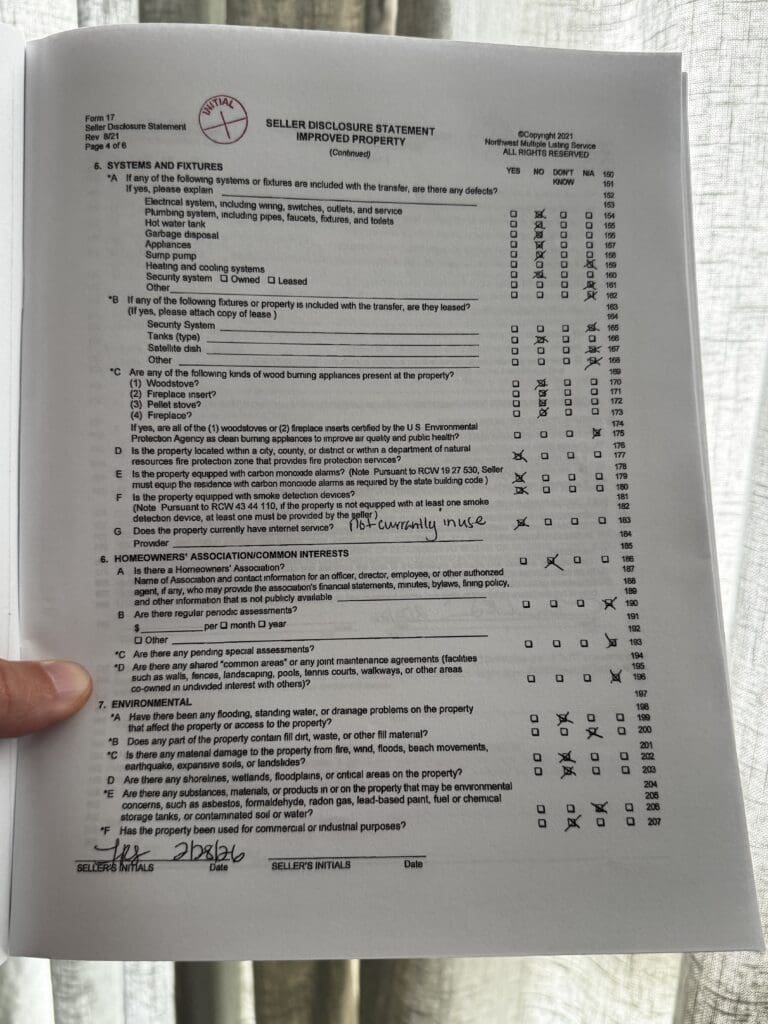
Do a walkthrough before you list. Yes, the freezer in the garage counts.
This one causes more closing-table friction than it should, and it is almost entirely avoidable. Fixtures, appliances, and items you might consider personal property can become disputed when they are not clearly addressed in the listing from the start.
The dining room chandelier you planned to take with you. The garage refrigerator you use for beverages. The custom window treatments in the primary bedroom. The built-in shelving unit in the office. Buyers often assume these stay. Sellers often assume they go. When there is no clarity in the listing agreement and the purchase contract, you get a negotiation at exactly the wrong moment.
Walk through your home with your agent before you list and make two lists. What stays. What goes. Put both in writing. It takes thirty minutes and it saves hours of friction later.
In Washington State, fixtures are generally assumed to convey with the home unless excluded in writing. Personal property is generally assumed to leave unless included in writing. When in doubt, specify. An item included in a listing is a selling point. An item that becomes a dispute at closing is a headache and sometimes a deal risk.
Last week I heard about a seller working with another agent who was frustrated after 30 days on market without an offer. Thirty days. In a national market where days on market is rising past that as an average, 30 days is not a crisis. It is close to normal. But this seller had been told to expect offers in the first weekend, and when that did not happen, the whole experience felt like a failure.
That is an expectation problem, not a market problem. Setting realistic expectations from the start is part of what good representation looks like. A seller who understands the range of outcomes going in is a seller who can make clear decisions when the market gives them real data to work with.
Mistake #8: Assuming Multiple Offers Always Means a Higher Sale Price
Multiple offers is a good problem. It is not a guarantee of the number you want.
When offers come in, sellers sometimes assume the highest number on the page is the best deal in the pile. That is not always true. There are a lot of ways to structure a real estate transaction, and price is only one dimension of them.
An offer that is $20,000 higher but comes with a long inspection contingency, a financing contingency with a lender you've never heard of, and a closing timeline that doesn't match your needs may be worth less in practice than an offer that is $15,000 lower with a clean pre-approval, a short inspection window, and a closing date that works for you.
Escalation clauses, waived contingencies, rent-back provisions, earnest money amounts, the strength of the buyer's lender, all of these matter. Your agent should be walking you through the full picture of each offer, not just sorting them by price and pointing to the top of the list.
When you receive multiple offers, ask your agent to build you a side-by-side comparison of the key terms, not just the prices. Net proceeds after concessions, timeline, contingency structure, and buyer qualification strength should all be on the table before you decide.
Mistake #9: Unrealistic Expectations About Timeline
Patience is a strategy. Know the real numbers before you decide whether your timeline is a problem.
The national average for days on market has been rising, according to the National Association of Realtors. In some segments of the Greater Seattle market, a listing that sits for 30 days is performing at or near the national average. That is not a failing listing. That is a listing that has not yet met the right buyer.
Sellers who go into a listing expecting weekend offers and then panic at day 21 make reactive decisions. They drop the price before the market has had enough time to speak clearly. They accept terms they would not have accepted if they had waited another week. They confuse timeline with value.
A good agent will set your expectation range before you list, not after you start asking questions. If your home is well-priced, well-prepared, and properly marketed, patience is not a passive position. It is a strategic one.
The 9 mistakes Bothell home sellers make are not mysteries. They are patterns. Overpricing, wrong comps, chasing the market, skipping agent interviews, bad photos, no pre-inspection, fixture disputes, misreading offer stacks, and unrealistic timelines. Every one of them is avoidable. Every one of them costs money when they're not. The sellers who do best in Bothell are the ones who walk in with a real strategy and a realistic picture of what to expect. That conversation starts before you list. Not after.
Frequently Asked Questions
What is the biggest mistake home sellers make in Bothell, WA?
Overpricing is the single most common and most costly mistake Bothell sellers make. It happens when sellers price based on what they feel the home is worth, what they paid for it, or what they need to net, rather than what the current market data actually supports. A home priced above comparable sales in its specific neighborhood takes longer to sell, attracts fewer qualified buyers, and often ends up closing for less than it would have if it had been priced correctly from the start. The fix is a comp-based pricing strategy built around recent closed sales in the same neighborhood, not the same city.
Should I get a pre-inspection before selling my home in Bothell?
A pre-inspection is not the right move in every situation, but in an active market like Bothell it is worth a serious conversation with your agent before listing. When done well, a seller-ordered pre-inspection identifies issues before they become buyer leverage in negotiation, allows the seller to address items at their own pace and cost rather than under deadline pressure, and gives buyers more confidence moving quickly. It is most effective when the seller is willing to address the findings rather than simply disclose them. Ask your agent whether the current market conditions in your specific neighborhood make it a strategic advantage.
How many real estate agents should I interview before selling my Bothell home?
Interview at least three agents before signing a listing agreement. The goal is not to collect opinions. It is to understand how different agents would price your home, what they would recommend you do before listing, and how they have performed in your specific neighborhood. Ask each agent to show you their recent sales within your neighborhood, not just their overall volume. Ask how they would handle multiple offers. Ask what they think is the single biggest factor that will determine your sale price. The agent whose answers are most specific, most honest, and most grounded in data for your actual street is the one worth hiring.
Does staging really help when selling a home in Bothell?
Yes. Staging, combined with decluttering and professional photography, consistently returns more than its cost for Bothell sellers. The reason is that most buyers today screen listings online before booking a showing. Listing photos that show a clean, well-lit, thoughtfully arranged home generate more showings than photos that show personal clutter, tight furniture arrangements, or rooms that look smaller than they are. More showings from qualified buyers means more competitive pressure, which supports price. Staging does not need to be expensive to be effective. Decluttering and rearranging what you already have, paired with a professional photographer, is often enough to meaningfully improve your listing's first impression.
Does getting multiple offers on my Bothell home guarantee a higher sale price?
Multiple offers give you leverage, but they do not guarantee a higher net. The highest-priced offer is not always the best offer. Factors including contingency structure, buyer financing quality, earnest money amount, closing timeline, and any seller concessions requested all affect what you actually walk away with. A well-qualified buyer at a slightly lower price with a clean contract and a strong lender can easily outperform a higher offer with weak financing and a long inspection contingency. Your agent should present you with a full terms comparison of every offer, not just a ranking by price.
How long does it take to sell a home in Bothell, WA right now?
Well-priced and well-prepared homes in Bothell are going pending in as few as four to seven days as of May 2025, according to NWMLS data. Homes that are overpriced or underprepared are taking 30 days or more, which is close to the rising national average per the National Association of Realtors. The difference between those two outcomes is almost entirely explained by preparation and pricing strategy, not by market luck. Sellers who go in with realistic expectations, clean presentation, and honest pricing are the ones seeing the fastest results. Sellers who test the ceiling and then chase the market down typically spend more time on market than they planned and close for less than they hoped.
Want to Sell Your Bothell Home Without Making Any of These Mistakes?
Let's have the conversation before you list. I'll tell you exactly where sellers in your neighborhood are leaving money on the table and how to make sure you don't.
Talk to Aaron Before You List